

Most households never decide whose name goes on things.
They answer a series of forms.
Whoever arrived first opened the first account. Whoever was being paid locally got the local salary account, because that is the account payroll asked for. Whoever’s employer issued the visa became the sponsor, and the other person became the dependant — which is a word on a residence permit, not a description of a marriage. The investment account went in the name of whichever of you could open one from where you happened to be sitting. The pension belongs to whoever had the job that came with one.
None of that was a decision about ownership.
It was a sequence of eligibility answers, given at speed, in years when there were other things to do.
The names on a household’s assets
are mostly a record of who was eligible.
Not of who decided.
Why it concentrates in a mobile life
A household that stays in one country accumulates names slowly, under one system, with one set of rules. Over twenty years things tend to even out — not because anyone planned it, but because both people keep passing through the same institutions.
A household that moves does not get that. Every move restarts the eligibility question from the beginning. Residency, payroll, account opening, credit history, the local rule about who may hold what. All of it resets, and all of it resets around whichever job caused the move.
So the names do not even out. They concentrate.

Two questions that are not legal questions
This is where writing on this subject usually goes wrong, so it is worth being exact about what Athena is and is not saying.
What “joint” actually means, what a named beneficiary does, what happens to an account when one of two people dies — all of that depends on the country, on the institution, and on the particular household. It differs between the UAE and the UK. It can differ between two banks in the same city. Athena does not answer those questions in a letter, and a reader should be wary of anyone who does. They are answered once, in writing, for your situation, by someone qualified in the relevant jurisdiction.
But there are two questions underneath all of that which require no legal knowledge at all. Almost no household has written the answers down.
01 Whose name is it in? Not “ours.” The actual name on the actual document, line by line: each account, each policy, each property, each pension, each investment account.
02 Who could reach it on an ordinary Tuesday? Without a phone call to the other person. Without a signature from someone in a different time zone. Without a password that lives in one person’s head.
The first is a question about ownership. The second is a question about access. They are not the same question, and the answers come apart more often than people expect — in both directions.

The part that falls unevenly
In a household that moved for one person’s job, the other person’s name tends to end up on fewer things.
That is not a claim about anyone’s intentions. It is a consequence of the order the forms were filled in. The job that moved held the visa, so it held the sponsorship. It held the local payroll, so it held the local account. It came with the employer scheme, so it holds the pension. The other career, if it continued at all, continued somewhere that was no longer issuing the documents.
In internationally mobile households, that second person is very often a woman.
That is a description of how mobility works. It is not a grievance, and it is not a comment on anybody’s marriage. The households where the pattern is most pronounced are frequently the closest and the most settled, and that is precisely why it goes unnoticed. Nobody is keeping score, so nobody is keeping a list.
What this letter is not saying
It is not saying to separate anything. It is not saying to move money, open parallel accounts, or treat the person you live with as a risk to be managed. Athena does not write that letter and would not be worth reading if it did.
The point is narrower, and it is practical.
A household can be entirely united and still be administratively lopsided — and the lopsidedness stay invisible until the ordinary day it matters. One of you is on a plane. A renewal falls due. A bank wants a signature in person. A school wants a transfer today. A parent in another country needs something done this week.
On that day the problem is never trust. It is reach.
Add one column
Two Sundays ago this letter argued for a single page: everything a household holds, and where each of it lives. If that page now exists, it has a column for what and a column for where.
Add a third. Whose name.
Then put a mark beside every line only one of you could act on without the other. Not a column. Just a mark.
That is the entire exercise. It takes an evening. It produces no decision, recommends no product and changes nothing by itself. What it produces is one page two people can look at together, which is something most households have never once had.
And there is a quiet second use worth naming. That page is also the single most useful document a household can hand to anyone it eventually asks for help — because the first hour of any good planning conversation is almost always spent assembling it, slowly, out loud, from memory.
A list of what you own is an inventory.
A list of whose name it is in is a plan.
One last distinction
Ownership is settled in documents, and documents are slow, formal and country-specific. Access is settled on weekdays, by whoever has the login, the card, the local number and the standing to walk into a branch.
Most households have given a great deal of thought to the first and almost none to the second. The second is the one that decides what an ordinary Tuesday feels like.
The Athena Question
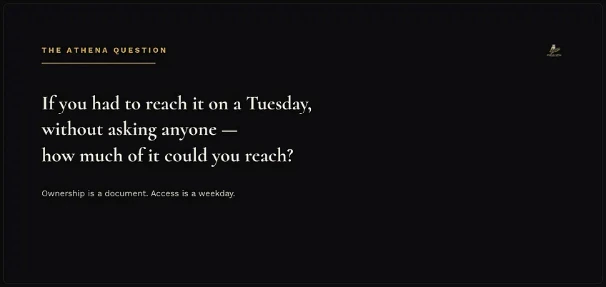
If you had to reach it on a Tuesday, without asking anyone — how much of it could you reach?
Ownership is a document. Access is a weekday.
Independent wealth consulting for internationally mobile professionals
@athena_capital_consulting
Cross-border wealth, made clear.