

Ask most people in Dubai what financial risk means, and they will describe a number going down.
It’s a fair answer. It is also the smallest part of the truth for someone whose life crosses borders.
Volatility is the risk that announces itself. It arrives with a chart, a percentage and a headline. It is uncomfortable, it is visible, and for a long-term investor it is usually the one that matters least.
The risks that quietly decide how a cross-border life turns out do not arrive that way. They have no ticker. They don’t fall on a Tuesday. They sit inside the structure of a plan, doing nothing at all, until the day something changes.
What risk usually measures
The industry measures risk as volatility — how much a portfolio moves around its average. It is measured that way because it can be. It is a number, it updates daily, and it fits in a column.
Volatility is real and worth understanding. But it describes one thing: how bumpy the ride is.
It says nothing about where your money is, whose legal system it sits in, what currency your future costs are in, or whether your plan still works if you are living somewhere else.
For someone who has lived in one country their whole life, that gap barely matters. For someone in the UAE with a career in one place, savings in another and a retirement imagined in a third, it is a large part of the picture.

A portfolio can be diversified
and a life can still be concentrated.
Five things most people get wrong
01 Treating volatility as the whole of risk. A portfolio that falls and recovers is an event. A plan that only works in one country is a condition.
02 Counting assets by type, not by jurisdiction. A portfolio can hold ten asset classes and still sit almost entirely inside one legal and banking system. Diversified by what you own. Concentrated by where it sits.
03 Assuming liquidity. What can be sold, and what can be sold quickly, from abroad, without a local bank account and without waiting for a buyer, are two different lists. Most people have only written the first.
04 Ignoring the currency your future costs are in. Earning in dirhams is straightforward while you spend in dirhams. It becomes a question the moment a meaningful future cost — a university, a move, a retirement — is priced somewhere else. One factor among several, not the whole of it.
05 Building a plan that requires you to stay, without deciding to stay. Staying in the UAE is a real and increasingly common choice. So is leaving. The problem is not either answer. It’s a plan that silently assumes one of them.

The risks with no ticker
Here is the distinction worth keeping.
Volatility is a property of a portfolio. Concentration is a property of a life.
You can look up the first on any platform. The second you have to go looking for — and it is usually found not by adding up what you own, but by asking what your plan assumes.
Residence in the UAE is generally tied to something: an employer, a property, or one of the longer-term routes. Savings usually sit with one bank in one country. An end-of-service entitlement attaches to a single contract. None of those are problems. All of them are dependencies, and dependencies are what structural risk is made of.

A better starting point
Take an expat we’ll call Elena. She is 44 and has been in Dubai nine years.
Her portfolio is diversified — global equities, some bonds, a property. On any risk questionnaire it comes back moderate.
Now list what her plan quietly assumes. That she keeps the job. That the property can be sold when she wants, rather than when a buyer appears. That the bank she has used for nine years stays convenient from wherever she goes next. That the country she pictures retiring in still costs roughly what it costs today.
Four assumptions. Not one of them is unreasonable. Not one of them appears in her portfolio’s risk score.
Elena’s investment risk is moderate. Her plan risk sits in one employer and one country, and nothing on her statement says so.
The useful exercise isn’t “how far could my portfolio fall.” It’s “what would have to stay true.”
Volatility is the risk you can see.
The rest, you have to go looking for.
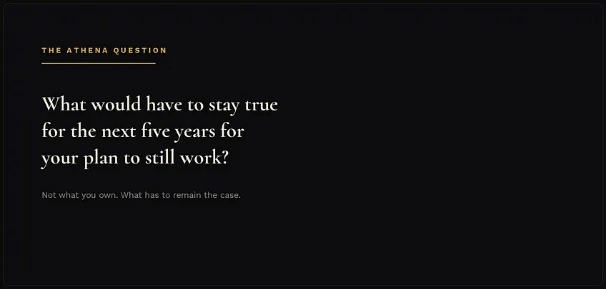
The Athena Question
What would have to stay true for the next five years for your plan to still work?
Not what you own. What has to remain the case.
Independent wealth consulting for internationally mobile professionals
@athena_capital_consulting
Cross-border wealth, made clear.